
What are Meta Ads, and How Do Meta Ads Actually Convert in 2026?
Meta Ads helps your brand reach people as they scroll, watch, or shop across Facebook, Instagram, and Messenger. In other words, they are sponsored ads that help you reach your target audience at the right time. From a marketing perspective, they are important because they help you achieve results with control & targeting. Several businesses work with a Meta Ads Agency in India to make marketing strategies, budgets, and audience signals work together for consistent results.
In 2026, Meta Ads results will be achieved through better automation and data usage. Advantage+ is an ad tool that allows you to optimise your ads in real-time. First-party data and the Conversions API help you track results better. Also, ad formats such as click-to-message ads are effective at driving immediate results. A professional Meta Ads Agency in India will help you leverage these features to target people who are ready to buy.
What Are Meta Ads Today?
Meta Ads currently operates within a single ad system that allows advertisers to select an objective, upload ads, specify a conversion event, and then enable Meta’s system to compete for ad impressions. Meta Ads objectives have become simpler since Meta’s recent changes, which have resulted in ads being more closely aligned to objectives such as awareness, traffic, engagement, lead generation, app promotion, and sales. This is significant because it informs Meta’s system about the type of user action it should prioritise.
Placements are the places where the ad will appear. These are Facebook Feed, Instagram Feed, Instagram Stories, Instagram Reels, Messenger, and Meta Audience Network. Meta Audience Network expands the reach of Meta Ads to other apps and websites outside of Facebook. Meta recommends that advertisers use automatic placement coverage. This is because the system will be able to allocate impressions to lower-cost, higher-performing places.
The process of the auction itself is not as complicated as it might sound. A Meta Ads Agency in India realises that, as an advertiser, you’re not actually buying a specific number of individuals who will see your ad. Rather, it’s a system in which Meta considers your bid or cost control, your estimated action rate, and your ad quality signals to determine which ad wins the impression.
This is why, even if you have a high budget, a lack of creativity can actually hold you back in terms of being able to scale. On the other hand, having good creatives, as well as good conversion signals, can actually help you scale more efficiently. A Meta Ads Agency in India focuses on optimising these signals because, as mentioned, it’s not actually buying you views. Rather, it’s a sophisticated system in which it’s trying to determine which impressions will actually help you get the results you desire.
How Conversion Actually Happens in 2026?
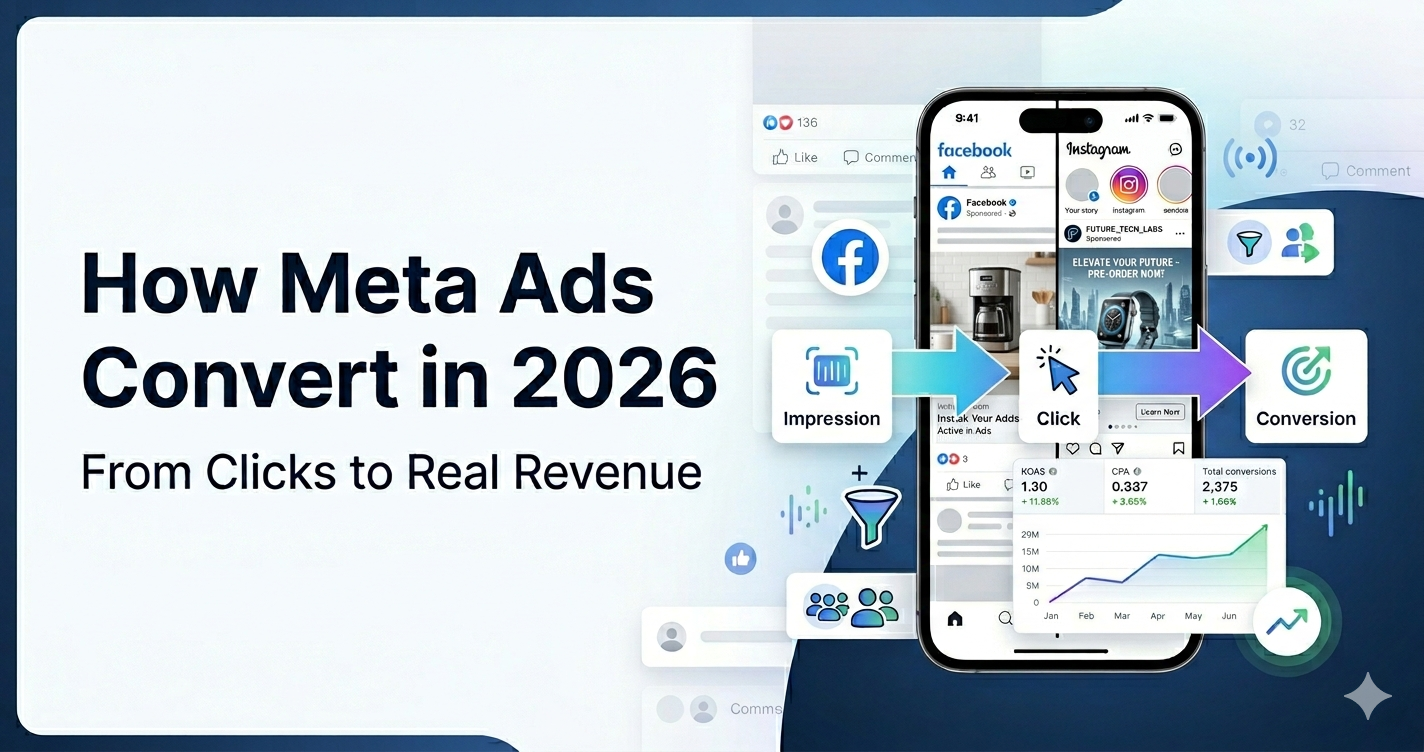
A conversion event on Meta happens after a chain of events rather than a single event. An individual sees an impression. This can be in Feed, Stories, or Reels. Then an individual clicks, watches, or recalls an ad. Next, an individual goes to a landing page, instant experience, product page, or lead form. Finally, if an individual completes a desired action, like a qualified call or form submit, then Meta attempts to connect that action to the ad exposure.
The chain model functions well if the event being optimised is important and measurable. The pixel is browser-side code that tracks actions that take place on your website. The pixel helps Meta measure events, build audiences, and optimise ad delivery. In 2026, the pixel is somewhat important, but not as important as server-side tracking with Meta Conversions API, because browser data is not as complete as it used to be. Meta says Conversions API is a more dependable direct connection to your marketing data and Meta, which helps with website, app, offline, and messaging events.
Why server-side matters: Due to browser limitations, consent selections, ad blockers, or network issues, there may be gaps in client-side tracking. With Conversion API, events are sent directly from your server, website platform, application, or customer relationship management system. This makes Conversion API more robust and often results in better matching and optimisation.
When you use pixels and Conversion API together with the same event ID, we’re able to deduplicate events rather than double-counting them. Then, we use these events to optimise. When you’re optimising for conversions, we find people who are similar to people who have converted in the past. When you’re optimising for leads, we find people who are likely to submit a form or complete an event you’ve defined. This is why poor event setup results in poor results. This means that if your “lead” event occurs too early or your thank-you page is not functioning correctly, we’re essentially learning from bad data.
The learning phase is part of this process. Meta states that an ad set exits the learning phase after performance stabilises, normally after approximately 50 optimisation events, because of the last major edit. This is why edits to an ad can cause it to go back into the learning phase. Conversion volume and signal quality are more important than sophisticated targeting techniques.
What’s New or Different in 2026 That Impacts Conversion?
The most notable change today is that automation has a bigger impact on performance on Meta. A Meta Ads Agency in India understands that with the Advantage+ product family, machine learning helps to minimise the need to manually set up, as well as to allow the system to discover high-performing audiences and placements with greater flexibility.
Advantage+ Shopping Campaigns (ASC) are created for performance-driven advertisers who are looking to boost their online sales. In the same way, the Advantage+ audiences feature reflects this approach that Meta is taking. This is why a Meta Ads Agency in India understands that automation has to be leveraged to achieve better results.
This doesn’t mean targeting is no longer important. It’s just that manual targeting works in a different way. Broad targeting in 2026 can perform well when the ad conversion tracking is clean and the creative is strong. Lookalikes also have value when first-party seed data is strong. However, several advertisers are now finding that extensive prospecting with strong signals can outperform audience targeting. The reason is simple: the system requires room to explore. Several narrow filters limit the number of auctions the system can enter.
Another important thing is that creative automation is now more significant than ever. This is because different content can be allocated to different placements. The best combinations can then be chosen based on the availability of the content. This is in addition to the fact that reel-first behaviour has led to a preference for shorter hooks. This behaviour has also led to content being created in vertical formats. This is because this type of content works best on mobile. Facebook Reels/Instagram Reels ads are now included.
Another thing worth noting is that the way your business thinks about conversions has changed. This is true with the introduction of the Digital Personal Data Protection Act. This act further includes the 2025 rules as well. This act is the framework for the utilisation of digital personal data in India. This act doesn’t affect the ad system at all. On the contrary, it further affects the way your business thinks about data minimisation and consent when collecting possible leads.
Building a Full-Funnel Strategy That Converts in India
Meta conversions don’t do well in isolation. A full-funnel approach is a good strategy because, at any given point, there are different stages. A hot audience needs little convincing. A warm audience needs some proof. A cold audience needs some context. They just need to be shown the right timing.
The awareness stage isn’t about trying to get people to purchase at all costs. It’s about trying to get qualified attention. Useful problem framing, video views, or Thumb-stopping hooks can be good at trying to help Meta learn who pays attention. Attention is a scarce resource in India, and people are emotional about rates on the basis of the category. Awareness advertisements need to be able to show people value. Reel ads can be good at this because they’re a very relevant ad format in today’s mobile-first world.
The middle part of the funnel includes moving from “consideration” to “interest.” This includes retargeting, product education, lead magnets, and product reviews. This is mainly because, if an individual has watched a lot of video or has checked out your rate page, they are giving you a stronger signal than if they are merely seeing an advertisement. This is where ad retargeting comes in to give them another message.
The bottom part of the funnel includes landing page quality in addition to advertisement quality. This includes a fast landing page to ensure that a click turns into a sale. It also includes a short form to ensure that a person completes it. Whatsoever, not having enough qualifications may hurt the quality of a sale. When it comes to the Indian lead generation brands, the speed of follow-up is what can make or break a campaign. If you take 6 hours to call a lead, your campaign is probably not doing very well.
Targeting, Bidding, and Budgeting: How to Choose for Conversion
Broad Targeting is a great strategy when you provide an offer that’s popular enough, your advertisement copy is good at defining the purchaser, and your event data is strong. This gives Meta more room to manoeuvre to find pockets of potential buyers.
Lookalikes can be helpful if done well. This is specifically true for lookalikes targeting repeat buyers, quality leads, or recent buyers. This is mainly because they offer a strong foundation for Meta. Whatsoever, poor data equates to poor lookalikes. The core reason behind this is that if your initial audience had poor leads.
Remarketing is a winning strategy when your trust or sales cycle is longer is a factor. This is true for high-ticket items, business services, and education. The core reason is that when a person enters your website, puts something in their cart, or opens a lead form, they’ve already gotten past one of your hurdles. Therefore, the second time they see your ad, it can be more conversion-focused and specific.
In terms of bidding, the lower cost is probably the best option when you need a scale, and there’s room in the system for you to learn. The cost cap is a good option when you understand the cost and you need some control. Whatsoever, it can also limit delivery if the cost cap is set too low. The thinking behind this is simple: more control equals less volume.
It is important to note that a budget should be considered a funnel as well as a symbol of confidence. A Meta Ads Agency in India understands that during the learning phase, it is not recommended to distribute the budget across too many ad sets, as this may result in poor performance due to the dilution of quality signals. In most cases, it is recommended to use fewer ad sets with quality and consolidated data to achieve better performance than using a complex ad structure.
There is a simple math equation that every business must consider. For example, if the value of a lead is ₹3,000 at the gross margin level and the close rate is 20%, it is important to maintain a cost per lead below ₹600 to achieve profitability after operational expenses. Here is where a Meta Ads Agency in India plays a crucial role.
Creative That Converts on Meta in 2026
The reason why creative converts is that it changes the type of attention that is delivered pre-click. The first 3 seconds are important as users are scrolling at a rapid pace. Effective hooks are those that make the message relevant at that point. They name-check the outcome, audience, or solution before the user scrolls away.
Mobile-first framing is crucial because most of Meta’s consumption is done on mobile. If the text is small, then the key message is late in the ad, and the pacing is slow, then the ad misses out on the bidding benefit that high-engaging ads can give. Vertical video pacing and Reels-friendly content are no longer just a creative trend but an achievable reality for advertisers.
The style of user-generated content is effective as it is “native” to the platform. What this means is not that there is little work to be done, but rather that there is credible and easily understood creativity. Social proof is good to have, especially in terms of conversion probability, because it eliminates uncertainty. Offering clarity is good, too, as it lets users understand what’s coming next. In other words, if what is offered on the ad is not what is offered on the landing page, conversion rates will be reduced.
Compliance is another important factor. There is little point in making unsubstantiated claims, overpromising, or even resorting to “before and after” techniques, which are often misleading. Good creativity isn’t necessarily exciting. Good creativity is what is constant with the landing page, the buyer’s awareness, and the event.
Why Do Businesses Choose Rahul Social Advertising?
For businesses seeking expertise rather than trial and error, Rahul Social Advertising offers itself as a “performance-oriented Meta Ads Agency in India with a focus on Facebook and Instagram ad strategy, creative, reporting, and return on ad spend.” The company’s website claims to have a team of specialists, which includes Facebook Ads specialists, a reporting specialist, and a creative lead, indicating a workflow geared towards execution, measurement, and reporting.
Rahul Social Advertising introduces Rahul Rana, the founder, with 10+ years of Facebook Ads expertise, and claims to have his work featured by SEMrush. The team profile on the company’s website indicates a team of specialists in Facebook Ads, Google Ads, creative, and reporting, which is important to businesses seeking expertise since “Meta ad performance is typically improved when campaign, creative, and reporting are optimised together, not in silos.”
Rahul Social Advertising, as they themselves mention on their website, claims to specialise in profitable growth, return on ad spend, and conversion-centric campaign management. On their website, they have snapshots of their results for clients that have achieved results such as revenue growth, lead growth, traffic growth, and improved ad efficiency. So, for a brand that is looking for campaign management, but not only regular ad support, Rahul Social Advertising is definitely worth considering when choosing a Meta Ads Agency in India.
Wrapping Things Up
However, Meta Ads conversion in 2026 happens in a chain of good decisions. They need event signals, objectives, landing experiences, and creativity to convert. It does not convert with one single trick. It converts with the right combination of message, audience, follow-up, and measurement.
If you understand this chain, then it is easier to understand how to measure and improve the effectiveness of a Meta ad. And if you want to get help elsewhere, it is helpful to understand how a Meta Ads Agency in India tracks, measures, tests, attribution, or business math, so you can know what to do next.
